Open Letter to the New Zealand Ministry for Culture and Heritage re the European discovery of New Zealand. No II.

14 August 2016

Re: Te Ara: The Encyclopedia of New Zealand – recent updates to the summary on the European discovery of New Zealand

Dear New Zealand Ministry for Culture and Heritage,

I refer to our recent correspondence in respect of the European discovery of New Zealand and the updates to your venerable online resource in respect of the Portuguese and Spanish theories on the discovery of New Zealand.

The forward thinking changes made by Te Ara sparked a welcome literary debate on the genre, with articles in the New Zealand Herald, Te Wahanui, and recently in the New Zealand Listener Magazine.

My responses to those articles include:

A previous article in the Northern Advocate, also provides a good overview.

The result: We are in the midst of an intelligent debate about the European discovery of New Zealand and Australia. The glass appears to be cracking around the negative stigma that has surrounded the theories on the Portuguese and Spanish discovery of Australia and New Zealand for the past 30 years. These theories appear to be moving from being presented as fringe ideas to being discussed in the mainstream as real possibilities. And they are now being taught and assessed as possibilities, probabilities or otherwise in schools and universities. Dr Ross Ramsay, for example, at the Southern Institute of Technology is leading the way in this regard, putting the literature in front of students and asking for their assessment.

From my end, it is pleasing that societal knowledge and interest on this element of New Zealand history appears to be moving forward, and with that, further research will be completed, and the Portuguese and Spanish theories developed further.

Progress.

History wasn’t written in a day.

Sincere congratulations to the team at Te Ara and the Ministry for your major part in inspiring this discussion and I do apologise for the delay in getting back to you, it has been a rather busy period with family, profession, and a recent charitable goodwill mission to Seychelles and Madagascar. The modern day Conquistadors have been active in the Indian Ocean. Further details can be found here, if interested.

Now, to the updates in Te Ara on the European discovery of New Zealand.

I do have some comments and a query for you, if I may, and propose some alternative text for your kind consideration.

……………………………………………………..

Reference: The Short Story: The European Discovery of New Zealand

1)    The map presented in the encyclopedia is preceded by over 100 years by the Dieppe maps.

In my earlier letter dated 8 October 2015 I previously provided comment that the map that commences this section on the website, the Henricus Hondius 1641 map, is not the earliest map of the Terra Australis Incognita or of Australia and New Zealand. I provided an alternative below based on the 228 year old, well researched theory, that the Portuguese and / or  Spanish may have discovered Australia and New Zealand, a theory that has been taken seriously and believed by some of the top cartographers and historians of their time, from Alexander Dalrymple (1786); the British Admiralty (1803); Richard Henry Major (1859), George Collingridge (1895), José Toribio Medina (1918), Robert Langdon (1975 and 1988), Kenneth McIntyre (1977 and 1982), Dr Helen Wallis (1981), Roger Hervé (1983), and Peter Trickett (2007).

The literature is written by credible sources. As an example, the late Dr Helen Wallis’ (OBE) credentials included:

  • Map curator, British Museum (later British Library) (1967-1987).
  • Chairman of the standing commission on the history of cartography of the International Cartographic Association.
  • President of the International Map Collectors’ Society (1986).
  • Founder of The Geography and Map Section of the International Federation of Library Associations.
  • President of The Society for Nautical Research, 1972-1988, and President of the British Cartographic Society.

She was the top of her field, and completed a very detailed review of the maps. Her conclusion:

“… it is notable how many of these names are descriptive of physical features … others seem to record the events and personal associations of an exploring voyage, including saints’ names … It is clear that the land represents a discovery made on a European voyage or coastal exploration. Secondly, it was apparently not a region of settled and civilised populations whose peoples would tell a visiting expedition the names of towns and other places (in fact there is no sign of towns). Thirdly, the number of Portuguese names suggests that the voyage was made, or at least recorded, by the Portuguese. The flags on Desliens charts of 1561 and 1566 are more explicit, indicating a Portuguese discovery.”

Question: I would be grateful if you could let me know what the reason is for the venerable national encyclopedia appearing to ignore these maps and the literature (particularly Wallis’ experienced view) surrounding them.

Pending your response, and to assist, I have drafted for your kind consideration an alternative section for ‘The Short Story’ section, that provides a reasonable assessment of current knowledge and literature.

Alternative proposals:

In summary, I propose that the map that is currently presented in this section be removed as it is doesn’t represent current knowledge and literature. I propose it be replaced with the ‘Jean Rotz’ map of 1542, presenting the great southern continent in the global context, with a close up of the Vallard Map of 1547 to provide the New Zealand context. I also propose for consistency that a paragraph be added above the Abel Tasman section mentioning the Spanish and Portuguese theory – as it is included in the ‘long story’.

The alternative proposition is:

Proposal: Short Story: European discovery of New Zealand

In their search for the vast ‘terra australis incognita’ (the unknown southern land) thought to lie in the Pacific, explorers made daring journeys across uncharted waters.

They did not find the fabled continent, but they did find New Zealand.

Circumstantial evidence points to the possibility of the Portuguese and Spanish being the first Europeans to voyage to New Zealand, however the Dutchman Abel Tasman is first recorded as having sighted New Zealand, and the country was later mapped by James Cook, the British captain who dominates the story of the European discovery of New Zealand.


Jean Rotz Circular Chart - 1542, which it is theorised includes some of the eastern coastline of Australia and some of the North Island of New Zealand.

Jean Rotz Circular Chart – 1542, which it is theorised includes some of the eastern coastline of Australia and some of the North Island of New Zealand.

Vallard Map 1547 - the eastern coast of Australia with portolan realigned. Part of the North Island of New Zealand may be the island the 'Illa do Magna'

Vallard Map 1547 – the eastern coast of Australia with portolan realigned. Part of the North Island of New Zealand may be the island the ‘Illa do Magna’

Vallard Map 1547. The North island of New Zealand?

Vallard Map 1547. The North island of New Zealand?

The Short Story

Portuguese and Spanish voyages

There is a possibility that both Iberian nations voyaged to or were wrecked in New Zealand in the 1520s, with sixteenth century maps with coastlines similar to New Zealand and Australia, appearing on world maps from the 1540s. On the most detailed map, the Vallard of 1547, over 120 Portuguese place names appear on landmasses where modern day Australia and New Zealand are located, and in some places, the place names describe physical features that still appear in places on those maps today. There is, however, currently no ship’s journal making these discoveries definitive – a sighting of New Zealand was not recorded by a European until 1642.

Abel Tasman

In 1642 the Dutch explorer Abel Tasman sailed in search of the southern continent, which sixteenth century maps indicated was located in the South Pacific. Dutch merchants hoped this land would offer new opportunities for trade. Tasman discovered New Zealand on 13 December 1642, but after a bloody encounter with Māori in Golden Bay, he left without going ashore.

Shortly afterwards, a Dutch map maker gave the name Nieuw Zeeland to the land Tasman had discovered.

James Cook

The English navigator Captain James Cook sighted New Zealand on 6 October 1769, and landed at Poverty Bay two days later. He drew detailed and accurate maps of the country, and wrote about the Māori people. His first encounter with Māori was not successful – a fight broke out in which some Māori were killed. However, after this Cook and his men had friendly contact with Māori.

The naturalists Joseph Banks and Daniel Solander, who sailed with Cook, gathered a great deal of information about the country’s plants and animals. Their records formed the foundation for the modern study of New Zealand botany.

On two later voyages, Captain Cook used New Zealand as a base to prove that a great southern continent did not exist in the Pacific.

Citation: John Wilson and Winston Cowie ‘European discovery of New Zealand’, Te Ara – the Encyclopedia of New Zealand, updated 10-August-16.

………………………………………………………………………………………

Reference: The Long Story: The European Discovery of New Zealand

I have some comments on the ‘Before Tasman’ section. As always, comments are well intended with a view of bringing knowledge forward.

An earlier discovery?

The sentence: ‘Spanish or Portuguese ships sailing out of Callao or Acapulco, or from the East Indies, may have reached, or become wrecked on the New Zealand coast.’  

My view is that this sentence can be improved a little semantically – as the way it reads, it could be interpreted to mean that both Spanish and Portuguese ships sailed out of Callao, Acapulco and the East Indies. As you are aware, given the treaties of Tordesillas and Zaragoza, it was the Spanish that sailed out of Callao and Acapulco with the Portuguese sailing out of the East Indies.

Alternative proposal: ‘Spanish ships sailing out of the Philippines and Central and South American ports (Acapulco, Callao and Concepcion), and Portuguese ships sailing from the East Indies (Malacca and Ternate), may have reached, or become wrecked on the New Zealand coast.’

…………………………………………………….

The sentences: “But there is no firm evidence of Europeans reaching New Zealand before Abel Tasman in 1642. Although fragmentary information found in Portuguese and Spanish archives suggests at least the possibility of earlier arrivals, no one before Tasman reported the discovery of new land that can be identified as New Zealand.”

My view is that these two sentences can be improved by referring to the circumstantial evidence that support the Portuguese and Spanish case – maps, the existence of artefacts and a skull, and oral tradition, as opposed to ‘fragmentary information found in Portuguese and Spanish archives’ which doesn’t reflect what the evidence is or where that information is located.

Similarly, none of the navigators put forward as the navigators who may have voyaged to New Zealand are included – Christopher Mendonca (Portuguese) and Juan Fernandez (Spanish).

Taking into account the above my proposal for the ‘An earlier discovery?’ section is as follows:

Alternative Proposal: An earlier discovery?

Spanish ships sailing out of the Philippines and Central and South American ports (Acapulco, Callao and Concepcion), and Portuguese ships sailing from the East Indies (Malacca and Ternate), may have reached, or become wrecked on the New Zealand coast.

Whilst no one before Tasman reported the discovery of new land that can be identified as New Zealand, circumstantial evidence including maps, references to voyages in archives, oral tradition, and artefacts suggest at least the possibility of earlier Portuguese or Spanish arrivals.

It is theorised that the ships that came closest to New Zealand before 1642 may have been those of the Portuguese navigator Christopher Mendonca (1522-24), that of the Spaniard Juan Fernandez (1576-78), with the wreck of a Spanish caravel, the San Lesmes, also a possibility in 1527. The expeditions of Spanish navigator Alvaro de Mendaña de Neyra (1595) and Portuguese mariner Pedro Fernandes de Queirós (1605–06), which touched the northern Cook Islands, are also possibilities.

It is unlikely that Arab or Chinese ships, which were trading in the South China Sea and Indian Ocean, were ever off the coast of New Zealand.

…………………………………………………………..

Terra Australis Incognita

My view is that the way this section is written, it appears to try and distance Portuguese and Spanish navigators from the south to make room for the ‘Terra Australis Incognita’ myth. E.g.

“…the tracks of European navigators like Mendaña and Queirós lay well to the north of New Zealand, leaving plenty of space for cartographers to place a terra australis incognita (unknown southern land) to the south.”

This Terra Australia term has its origins in theory with the likes of Aristotle, Ptolmey and Cicero – centuries before this –  there is no need to suggest that space needed to be left for it – as consistent with the theory that the southern continent was needed to balance the globe, it was already appearing on maps prior to Mendana and Queiros’ voyages.

As such, I propose that the following wording be used to describe the Terra Australis Incognita.

Alternative Proposal: Terra Australis Incognita?

The discovery of New Zealand and Australia has always been bound up with speculation about the ‘Terra Australis Incognita’ – the ‘great southern unknown’ landmass, originally theorised about by the likes of Aristotle and Ptolmey. It was considered that a southern landmass was needed to counterbalance that in the north and even given the existence of the sixteenth century Portuguese maps and Tasman’s maps in this part of the world, it wasn’t until the voyages of Captain James Cook that the myth was finally dispelled.

Citation: John Wilson and Winston Cowie ‘European discovery of New Zealand’, Te Ara – the Encyclopaedia of New Zealand, updated 10-August-16.

……………………………………………

I would be most grateful for your view and response, Te Ara, to my question and proposed text amendments.

May I also state how professional and responsive I have found you in this korero, Te Ara. When-ever I have messaged there has been a prompt response. I am grateful to you and thank you once again for serious consideration of what has become an important national korero.


With Kind Regards,

Winston Cowie

Author – Conquistador Puzzle Trail

United Arab Emirates


New Zealand Discovery History: Cracking the myth and moving from fringe to mainstream: the Portuguese and Spanish exploration theories

Good news. We are in the midst of an intelligent debate about the European discovery of New Zealand and Australia. The glass is cracking around the negative stigma that has surrounded the theories on the Portuguese and Spanish discovery of Australia and New Zealand for the past 30 years. These theories appear to be moving from being presented as fringe ideas to being discussed in the mainstream as real possibilities.

Why?

Because of you – society – it is changing. People are information and knowledge hungry – you want to know the arguments for and against a topic and make up your own mind – as opposed to being told ‘this is what happened or this is what you should believe,’ or in academic circles, not having the discussion around the theories at all for fear of being criticised.

With the glass cracking, those that have written about the Spanish and Portuguese voyages theories over the past 228 years – the likes of Alexander Dalrymple (1786), Richard Henry Major (1859), George Collingridge (1895), José Toribio Medina (1918), Robert Langdon (1975 and 1988), Kenneth McIntyre (1977 and 1982), Helen Wallis (1981), Roger Hervé (1983), Ross Wiseman (1996), and Peter Trickett (2007), must be saying ‘about time.’

Some examples from these venerable historians.

New Zealand first.

In 1894, over 120 years ago, two of New Zealand’s most gifted historians, Dr Thomas Hocken and Dr Robert McNab, theorised that further research might reveal that the true story of the discovery of New Zealand had yet to be told, writing:

“Doubtless before Tasman, there were voyagers who had visited New Zealand … We are justified in thinking that there are buried in the old archives of Portugal and of Spain journals which, if found, would give an earlier account of New Zealand than those which we consider our earliest … The iron-bound chests of Portugal and of Spain are the probable repositories of these treasures, or they may have been emptied into the Papal and monkish libraries … and may lie covered with the accumulated dust of centuries.”

Similarly, the late Dr Helen Wallis, United Kingdom based and the president of every cartography organisation imaginable, and who reviewed in detail the sixteenth century maps that are purported to indicate a discovery voyage of Australia and New Zealand, wrote, “The answer to the enigma may be regarded as non-proven, but with the balance of evidence in favour of a Portuguese discovery of Australia,” (1988).

What the likes of Hocken and McNab and Wallis indicate, and they are just examples, is that across multiple generations people have reviewed some of the evidence of Portuguese or Spanish exploration to New Zealand and Australia – the likes of the sixteenth century Dieppe Maps – and seen the same thing and drawn the same conclusion – that being that the Portuguese probably discovered Australia and New Zealand, and the Spanish may have also voyaged to New Zealand pre-Tasman.

And there are plenty more examples from some of the top writers of their generation.

In 2016, it appears that their work is finally coming to the fore.

Where have we got to in 2016?

  • Three government institutions in three different countries consider the Spanish and Portuguese discovery theories a possibility
  • We are currently in the midst of a debate on that possibility

Three government institutions in three different countries (New Zealand, Spain and Portugal) now consider the Portuguese and Spanish theories a possibility, and some a probability, following a review of the evidence presented in Conquistador Puzzle Trail, which presents both the excellent work completed by historians over the past two centuries and new original research.

New Zealand:

New Zealand’s well-respected and forward thinking national encyclopedia, Te Ara, have a high threshold for making changes to the encylopedia and seek to avoid the inclusion of content that is speculative or highly contentious. Ministry for Culture and Heritage chief historian Neill Atkinson recently stated: “after considering Winston Cowie’s recently published research, we felt that small changes to the text [re the Spanish and Portuguese] would improve the European discovery entry.”

Spain:

Well-structured and impeccably researched, this important work [Conquistador Puzzle Trail] will have a strong impact on the academic representation of conquistadors as well as a wide array of consequences for the future understanding of New Zealand history. We feel incredibly fortunate to witness such a thorough investigation into the history of New Zealand in which we can really appreciate the links shared with Portuguese and Spanish explorers. In our case, the confirmation of these ties between Spain and New Zealand will undoubtedly strengthen the positive relationship that our two countries already share and cherish. At the same time, we would like to acknowledge all of the time and energy devoted to the research that has gone into this investigative work. Throughout the pages, we discover new elements of New Zealand culture and history that invite us to truly believe that Mr Winston Cowie´s theory is correct. Congratulations on the completion of this excellent work.”

Pablo Mateu García, Educational Advisor of the Embassy of Spain, New Zealand.

Portugal:

A fascinating book and an important contribution for the investigation about the Portuguese having been the first Europeans to reach Australia and New Zealand almost 500 years ago.”

Paulo Cunha Alves, Ambassador of Portugal to Australia and New Zealand.

Both the Spanish and Portuguese embassies to Australia and New Zealand also kindly gave permission for their logos to be included on Conquistador Puzzle Trail as a sign of the cooperation and collaboration shared whilst researching and writing.

Conquistador Puzzle Trail - Back Cover Reviews

Conquistador Puzzle Trail – Reviews

Following the addition by Te Ara of Conquistador Puzzle Trail to the national encyclopedia’s references, in 2016 the Portuguese and Spanish discovery debate became a topic of discussion at the national level.

The New Zealand discovery debate

Following the recent forward-thinking initiative of Te Ara, the first recent nationwide article in the debate appeared, good news, although the presentation of the news was presented as a negative – with comments that were described as ‘rubbishing’ the Spanish and Portuguese theories dominating the national headline. That article and those comments can be found here.

My response to that article entitled ‘About that rubbish: The Portuguese and Spanish voyaged to New Zealand Pre Tasman,’ is located here, and provides a case study as to how the conversation in the media in respect of the theory has played out over the last 30 years. The conclusion – society deserves better than the dismissive rhetoric that it has been served up on this subject for the past 30 years. It is no longer relevant.

What is required is intelligent and respectful debate in order to move knowledge forward.

The New Zealand Listener Article

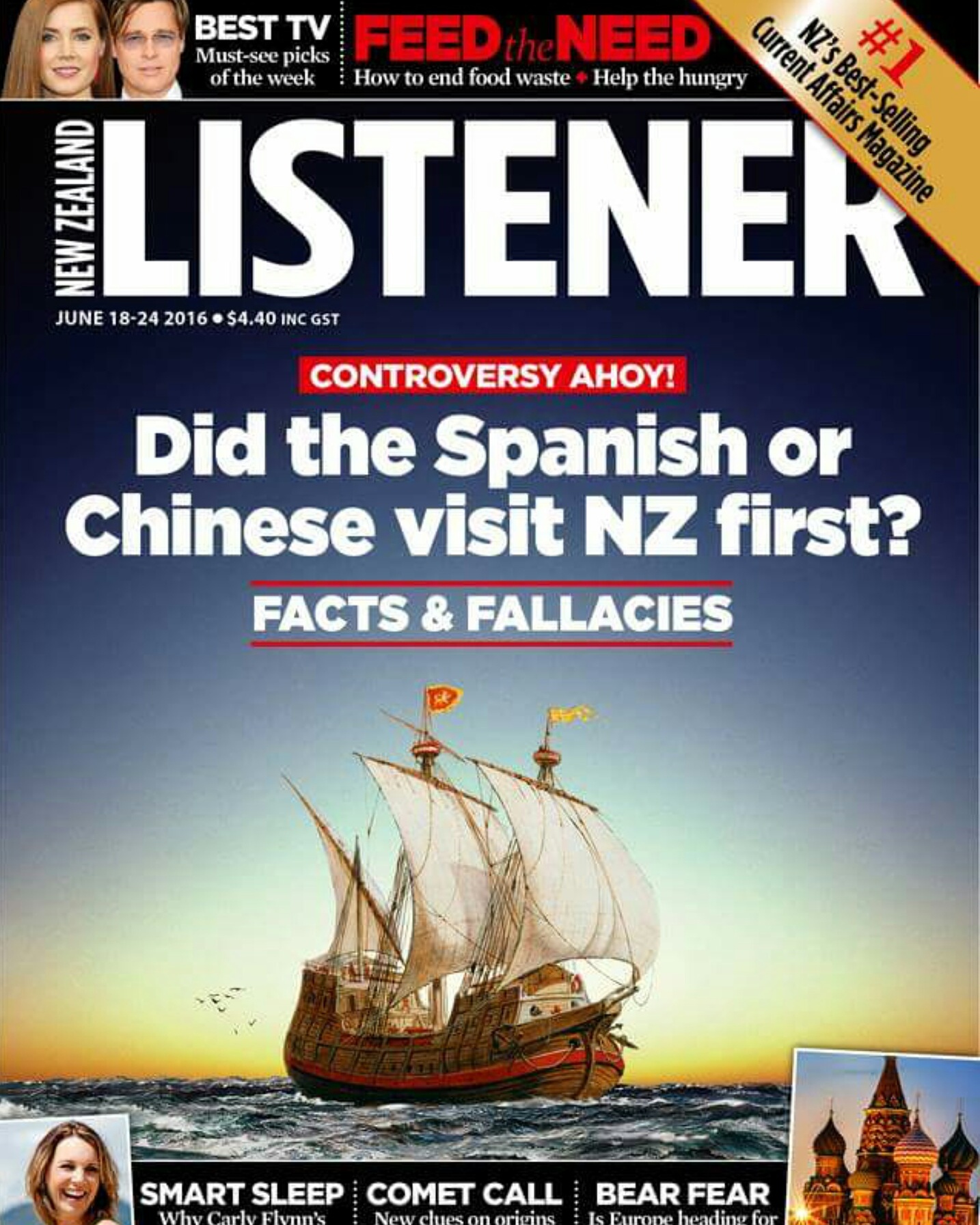
Enter the New Zealand Listener magazine, ever relevant and on point, who were the next to run a national article on the debate, entitled ‘Did the Spanish or Chinese visit New Zealand first?’

Winston Cowie Listener

It is an intelligently written article by Matthew Wright, a New Zealand historian and fellow of the Royal Historical Society, and as per the approach of the various government institutions, it well and truly brings the Portuguese and Spanish European discovery of New Zealand and Australia out of the shadows and into the plausible.

On this genre, it considers the Spanish Juan Fernandez discovery theory (1576-78), the Portuguese Christopher Mendonca theory (1522-24), the wreck of the fabled lost Spanish caravel, the San Lesmes theory (1527) and puts forward Wright’s view on them.

What a breath of fresh air to have those theories debated in New Zealand’s on point current affairs magazine and have a well-respected historian put forward his views on them.

With the comments of the three government institutions and the likes of the New Zealand Listener article, it appears that in 2016, the theories in respect of the Portuguese and Spanish discovering Australia and New Zealand are moving out of the shadows and into mainstream when discussing New Zealand’s European discovery history. As Wright writes in respect of history, this is not because of one reason or another, “mainstream historical theories by which we understand ourselves are not dictated from a central source. Historical understanding grows organically, from wide intellectual trends held across the field, in which New Zealand, usually, also reflects international thinking.”

And in this case study, the paradigm shift does exactly that and reflect international thinking – Spain and Portugal. I am also working on engaging with the relevant institution in Australia.

And so back to the debate – the interesting part.

Overall, once again, what a great article in a great magazine. There are always differences in opinion in historical debates, and Wright and I differ on four key points:

  • 1)    The Dieppe Maps;
  • 2)    The Juan Fernandez Spanish theory;
  • 3)    The San Lesmes Spanish theory; and
  • 4)    Where the Portuguese and Spanish theories should sit in Australian and New Zealand discovery theory.

The purpose in drawing these points to your attention, is to assist you in forming a view on the subject either way.

 1) The Dieppe Maps

The Dieppe Maps are the starting point of Iberian discovery theory and have been put forward as evidence of a Portuguese discovery of Australia and New Zealand for 228 years. These maps date to between 1542 and 1566 (over 100 years before Tasman) and I have written about them at length in Conquistador Puzzle Trail. A summary discussion of them can also be found in the below recent articles:

  • In my open letter to the Ministry of Culture and Heritage entitled: ‘Open letter to the New Zealand Ministry for Culture and Heritage re European discovery of New Zealand,’ dated October 2015. Click here.
  • In my article, ‘About that ‘rubbish’. Yeah Nah. The Portuguese or Spanish probably voyaged to New Zealand pre Tasman, dated May 2016. Click here.
  • In the recent article in the Northern Advocate, entitled: Conquistador Trail From Portugal to Pouto, dated August 2015. Click here.

Wright states in respect of the maps “Those maps also have to be understood in context of the belief – long held in Europe – that a great Terra Australis Incognita (unknown southern land) had to exist as a kind of global counterbalance to the land mass of Europe. Maps produced before and after the Dieppe ones speculated on likely coastlines. These fruits of cartographic imagination – sometimes decorated with curious graphics of men with faces in their stomachs and wild fantasy animals – bore little resemblance to reality; any similarity to coastlines found later was entirely coincidental.”

My issue with the statement is that it uses definitive language and directs the reader that they need to do something or think in a certain way – i.e. in this case interpret maps in a certain way. I would like to politely suggest that the reader compare those sixteenth century maps to the modern coastline of Australia and New Zealand, and be aware that in some places what the Portuguese names state on the map are descriptive of the very things that define those places geographically today. As an example of some of the 120 Portuguese place names that appear on the most detailed map (from 1547), at Fraser Island in Australia where there are pumice deposits, the word pomezita (pumice) is written; similarly where the word camronron appears, which means prawns, there is a modern day prawn fishery today. Where the Great Barrier Reef is: Costa Dangeroza – Dangerous Coast. The list goes on. The coastline of the continent is also similar to that of Australia and New Zealand – not in all places sure, but taken as a whole and to use Wright’s words the ‘context’ of cartography at the time (the context of which includes details on Jean Rotz who was considered a cartographer who never ventured into speculative cosmology) – on the basis of these maps alone, the serious and very tenable theory can be made, that the Portuguese discovered Australia and New Zealand.

As a footnote, I would like to point out that only one of the Dieppe Maps appeared in the article, and that wasn’t in the global terra incognita australis context (i.e. in the context of what was considered known of the globe at the time) that Wright suggests.

I include this context below.


Desliens Map 1566

Desliens Map 1566 (The global context)

Jean Rotz Circular Chart - 1542

Jean Rotz Circular Chart – 1542. The global context – Rotz was not known to deviate into speculative cosmography.


Jean Rotz Map 1542

Jean Rotz Map 1542


Vallard Map 1547 - the eastern coast of Australia with portolan realigned

Vallard Map 1547 – the eastern coast of Australia with portolan realigned


Vallard Map 1547 The North island of New Zealand?

Vallard Map 1547 The North island of New Zealand?


In summary on this point in the debate, we can agree to disagree on the relevance or otherwise of the maps to Australian and New Zealand discovery theory. We are only two – and in New Zealand there are over 4 million others that may sway the argument either way.

2) Juan Fernandez.

The second point I would like to raise in the debate is Wright’s statement in respect of the theory on Spanish voyaging to New Zealand pre-Tasman, particularly those around the Juan Fernandez (1576-78) theory. Writing on Spanish voyages to New Zealand, Wright writes:

There was no direct proof for any of this, but the concept was alluring enough for the Spanish Government, in the 1880s, to ascribe a 1576 “discovery” of New Zealand to Juan Fernandez, an explorer of colonial-era Peru and Chile.”

This statement is not true. There is no discussion in the literature in the 1880s of a Spanish voyage by Juan Fernandez to New Zealand. The theory wasn’t made until 1918 – nearly 40 years after this.  In respect of the Spanish government ‘ascribing a discovery’ because they were ‘allured to’, again there is no evidence at all of this – the theory was first made by a Chilean historian Jose Medina in 1918, in a little known book entitled: The navigator Juan Fernandez. When Medina’s theory did become more well known, the Spanish government embraced the theory, and indeed on the wall of the Madrid Naval Museum, is a wall mosaic celebrating Spanish exploratory voyages, and the route of Fernandez appears.

Conquistador Puzzle Trail provides further details.

3) The San Lesmes

The third point I would like to raise in the debate is Wright’s statement in respect of the fabled lost caravel the San Lesmes. For those interested in Pacific discovery history, please read the late Robert Langdon’s The Lost Caravel (1975) and The Lost Caravel Re-explored (1988) – a brilliant review of early Pacific voyaging and which contains Langdon’s San Lesmes theory.

Wright writes in respect of the San Lesmes:

The ship was never seen again and its fate remains unknown, but competing theories by Robert Langdon (1975) and Roger Herve (1983) postulate that the caravel blundered west, reaching either New Zealand or Australia before, perhaps, being wrecked on Amanu, an island in the Tuamotu archipelago.”

The issue with this statement is that neither Langdon or Herve state that the San Lesmes reached New Zealand or Australia before then being wrecked at Amanu in the Tuamotu archipelago.

Langdon’s theory is that the San Lesmes hit the reef at Amanu before voyaging to Tahiti then New Zealand, where he theorises it was wrecked at Kawhia, not at Amanu (which is in the middle of the Pacific).

Conquistador Puzzle Trail takes Langdon’s theory further discussing the possibility of the San Lesmes not being wrecked at Kawhia, but further north at Baylys Beach, Dargaville.

4) The conclusion as to where the Portuguese and Spanish theories should sit in Australian and New Zealand discovery theory.

After canvassing the Spanish and Portuguese theories, Wright comments in respect of the Spanish and Portuguese place in New Zealand discovery history:

“In the end the issue is academic. A proven pre-Tasman Iberian visit is unlikely to disturb our wider sense of place. History, as a way of understanding our human journey from past to present, is about wider trends. In that sense, even a demonstrable Spanish or Portuguese visit would be no more significant for our history than Tasman’s brush past our shores in 1642. That was the first time we can be sure that Europe found New Zealand. And that visit gave us our name – Nieuw Zeeland, probably chosen by Dutch cartographer Johannes Blaeu.

But the first significant European impact on Maori did not come until the arrival of British ne’er-do-wells, convicts, whalers, sealers and traders, broadly around the beginning of the 19th century. They brought the products of Britain’s industrial revolution – and the detritus of a British society in flux – into collision with traditional Maori life. So began a cascade of events that led to the colonisation of New Zealand by Britain – and, eventually, to New Zealand as it is today.

So even if records of a Portuguese or Spanish journey to our shores are found in dusty archives, or compelling archaeological evidence is discovered, this can only ever be a footnote – fascinating though it would be – to the well-established realities of our wider past.”

There are two statements here I would like to query. The first, in the first paragraph that “even a demonstrable Spanish or Portuguese visit would be no more significant to our history than Tasman’s brush past our shores in 1642.” The second, in the final paragraph “even if records of a Portuguese or Spanish journey to our shores are found in dusty archives, or compelling archaeological evidence is discovered, this can only ever be a footnote – fascinating though it would be – to the well-established realities of our wider past.”

I would like to contest the ‘significance’ comment  – which, as with the Dieppe Maps comments above, is written definitively. The comment basically says – even if the Spanish or Portuguese voyages occurred, they wouldn’t be significant.

Significance is different for individuals, localities, countries. If one of the theories was proven, on the contrary, it may be very significant to the Spanish and Portuguese governments – a source of pride – as I am sure Tasman’s voyage is to the Netherlands. Similarly, I also imagine that those hardy sailors who made those early maritime voyages, and who suffered scurvy, hunger and disease, would hope that they were more than a ‘footnote,’ in history.

On the significance of the theories, let’s see….It’s up to society to decide whether or not the theories are significant or otherwise.

So what’s next?

On the Portuguese and Spanish discovery question, there are more questions to be answered, more research to be explored more widely – there just needs to be the interest from society, students and teachers.

On this point, Dr Ross Ramsay, a lecturer at the Southern Institute of Technology, has taken the initiative and is seeking his student’s views on the subject.

Is there another history teacher in New Zealand or Australia who would like to review Conquistador Puzzle Trail and perhaps teach it as a unit of work in school or university? The first history teacher to get in touch and volunteer for the review, I will send you a free copy.

Finally, the myth that there is nothing to the theory in respect of the Portuguese and Spanish voyaging to Australia and New Zealand appears to be cracking.

Discussing these topics appears to be no longer ‘fringe.’

Did the Spanish and Portuguese voyage to New Zealand and Australia pre Tasman?

And if they did, what is the significance?

What is your view?

We can have a mainstream conversation.

Once again, thank you to the New Zealand Listener for being ever relevant and on point in publishing on this subject.

The debate continues.

Sincerely,

Winston Cowie

Wheelchairs, rugby and lemurs: The Arabian Gulf rugby community spreads goodwill in Seychelles and Madagascar.

Wheelchairs, rugby and lemurs: The Arabian Gulf rugby community spreads goodwill in Seychelles and Madagascar.

It was the morning of 26 June 2016, two day’s prior to the departure of the Air Seychelles Mike Ballard Foundation Conquistadors goodwill rugby mission to Seychelles and Madagascar. The Middle East based team, with players from clubs in the United Arab Emirates, Bahrain and Qatar, awakes to the news that there had been what was described as a terrorist attack at Mahamasina Stadium in Madagascar, killing two and wounding 80 people. The stadium was the very place where the Conquistadors were intending to play the Madagascar national side in a rugby match one week later.

To go or not to go – that was the question. We did a risk assessment – following the attack Madagascar was categorised as a ‘medium travel risk’ – the attack initially considered to be a ‘one-off’ associated with a national day rally. We asked the team – were they prepared to travel to Madagascar given the circumstances?

Two day’s later, and after monitoring the situation closely for any escalation, and after receiving assurances of increased security by the Madagascar Rugby Union, on the morning of the scheduled departure later that evening, 22 of the 24 person mission squad were ‘in.’

Excited and nervous we headed to Abu Dhabi Airport for the primary sponsor, Air Seychelles, flight to Madagascar via the Seychelles.

…………………………………………………………………………………………………….

Seven months earlier the team had formed under the banner of their good mate, Mike Ballard, an American national from Michigan who suffered a serious spinal injury whilst playing for the Abu Dhabi Harlequins in the 2014 West Asian Club Championship final.

At the time and over the ensuing two years, the Arabian Gulf rugby community supported Mike, who that year was nominated for the prestigious UAE Player of the Year Award.  Now back on top his rehabilitation after two determined and inspiring years (he broke every rehabilitation record at the Mary Freebed Rehabilitation Hospital in Michigan), Mike has moved back to Abu Dhabi to live and work, taking up a place at his old school, the “New England Centre for Children with Autism”, where his teaching greatly inspired the Autistic children and their families.

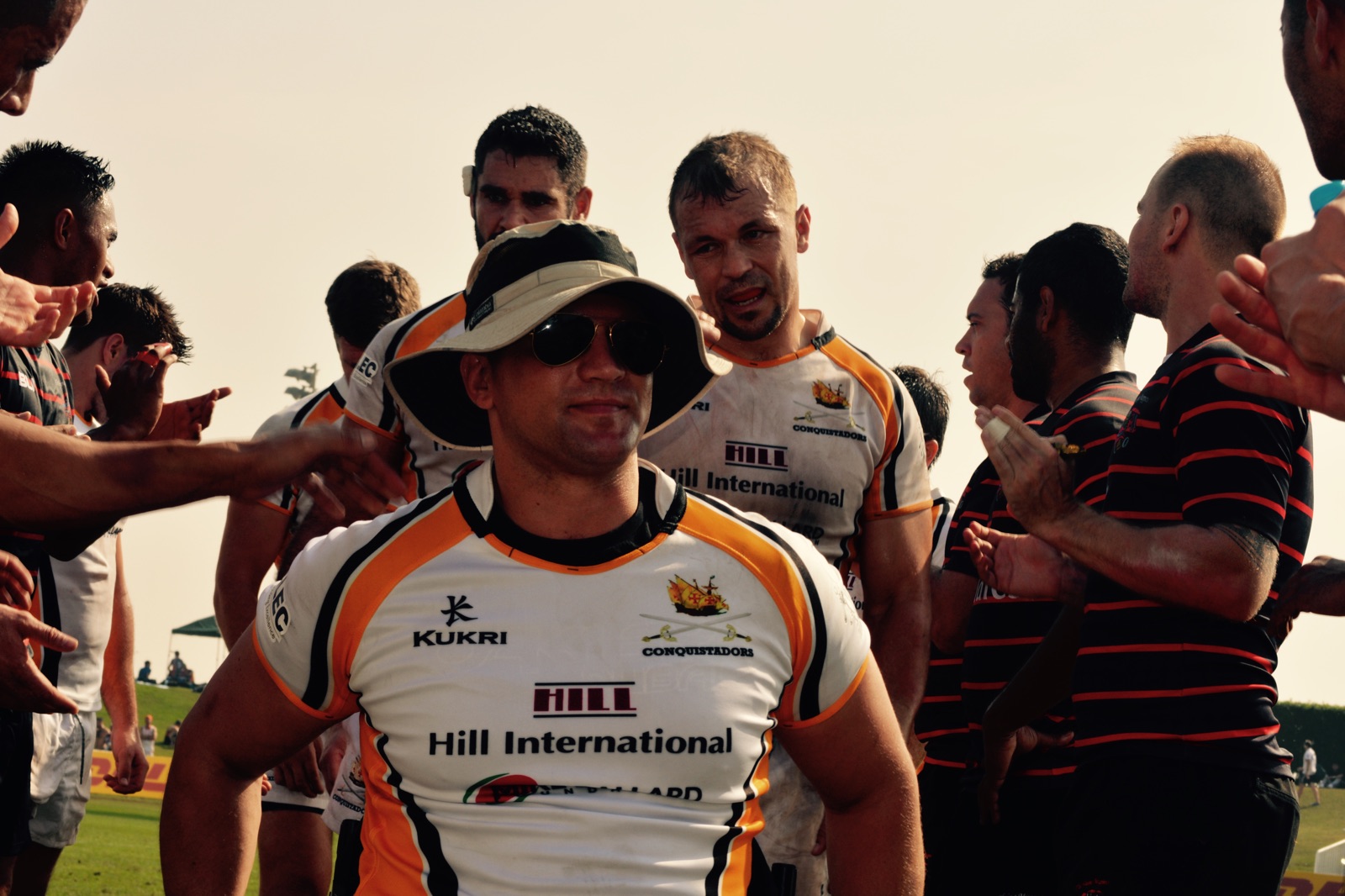
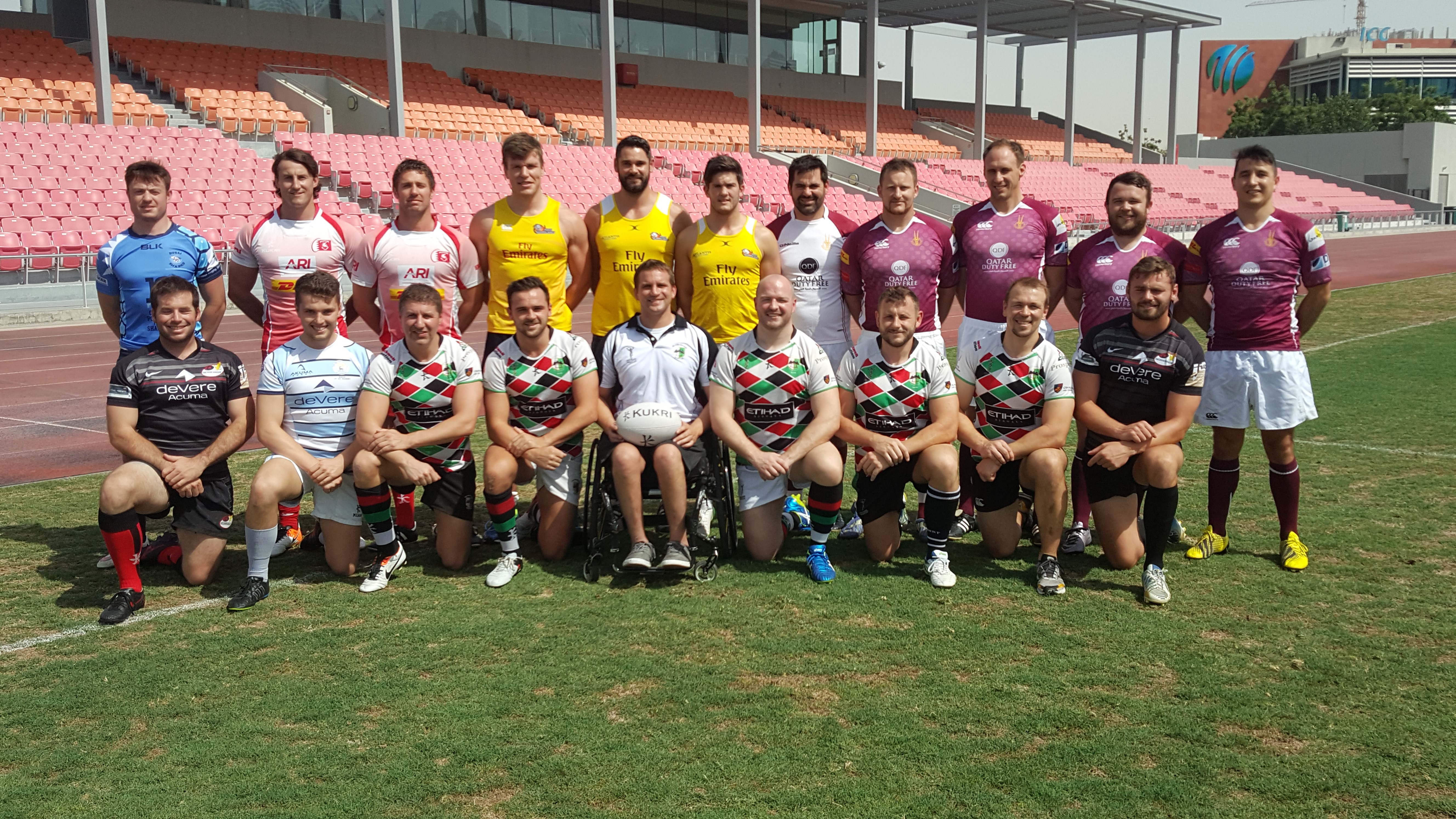
The Conquistadors were set up initially to support Mike with his move back to Abu Dhabi – and Mike arrived the night before the Dubai 7s – making it back to lead the Conquistadors onto the pitch at the Dubai 7’s in December 2015.

Mike Ballard and the Conquistadors

Mike Ballard and the Conquistadors


Mike Ballard Foundation Conquistadors and the Lewsey brothers, Ed and Josh, at Dubai 7s 2015.

Mike Ballard Foundation Conquistadors and the Lewsey brothers, Ed and Josh, at Dubai 7s 2015.

With the success of the team at the Sevens where they reached the semi finals of one of the local leagues, Mike and the team took the initiative to embark on an annual ‘good will’ mission to have a positive impact on the lives of others, through rugby union.

Mike Ballard comments:

“The support of the rugby community was a major driving force in getting me through my darkest hour when I was injured in 2014, and we formed the Conquistadors team soon after so we could help out other rugby communities around the world. On top of being a good a chance for us to further the sport of rugby, this trip is also an opportunity to improve the lives of people who may have suffered a spinal injury or have mobility problems for other reasons.  I want to thank Air Seychelles for making this goodwill mission possible.”

And so it was that we were enroute to Seychelles, six months after the Seychelles and Madagascar vision.

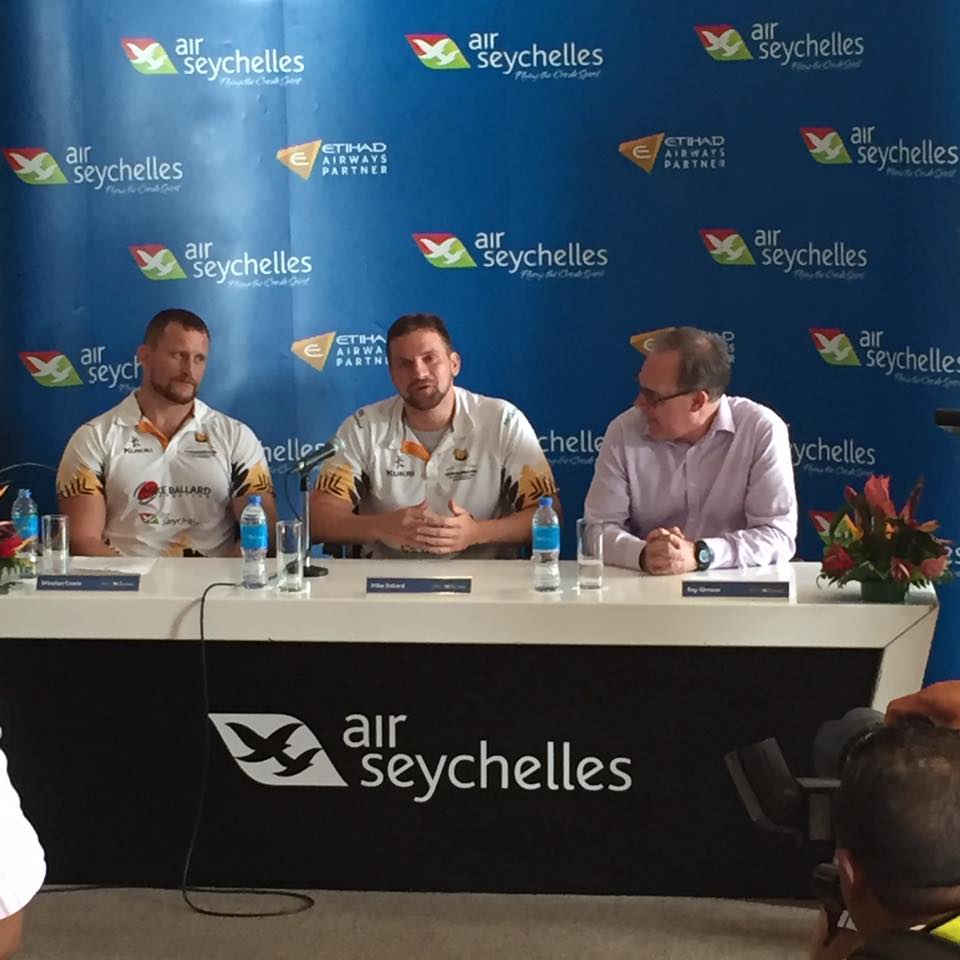
Seychelles and the Air Seychelles Press Conference

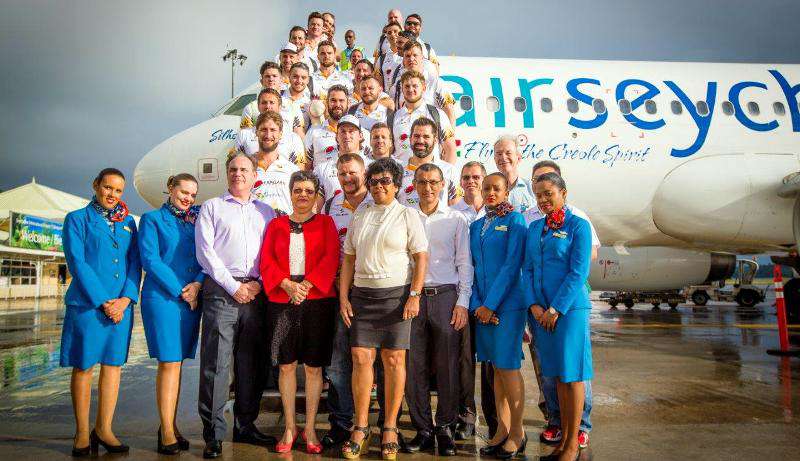
After a very comfortable flight (the management team were grateful to fly business class much to the team’s chargin), we were greeted upon disembarking by no other than the Seychelles Minister of Health, the honourable Mitcy Larue, the CEO of Air Seychelles, Roy Kinnear, members of the Seychelles Rugby Union and others. A fantastic press conference ensued and the team donated 20 wheelchairs to Seychelles hospital.

Air Seychelles Mike Ballard Foundation Conquistadors with Government Officials

Air Seychelles Mike Ballard Foundation Conquistadors with Government Officials

The honourable Mitcy Larue, the Seychelles Minister of Health, commented:

“We are thrilled to receive this generous donation of wheelchairs, which will go a long way towards improving the quality of life for people with disabilities, the elderly and other patients with mobility problems in Seychelles. The fact that it is coupled with the promotion of sports, which are an essential component of healthy living, makes this initiative doubly positive.”

Roy Kinnear, CEO of Air Seychelles commented:

“Air Seychelles is extremely proud to support this goodwill mission, which will benefit many people with mobility and physical impairments in both Seychelles and Madagascar. In addition to providing much-needed medical equipment, this initiative will also contribute to the development of rugby in the Indian Ocean region. We’re happy that as the national airline we can play our part in increasing engagement in sports. What this tour also demonstrates is the significant contribution of our four-per-week Antananarivo service to the growth of people-to-people, government and cultural ties, between our island countries as well as other markets such as the UAE.”
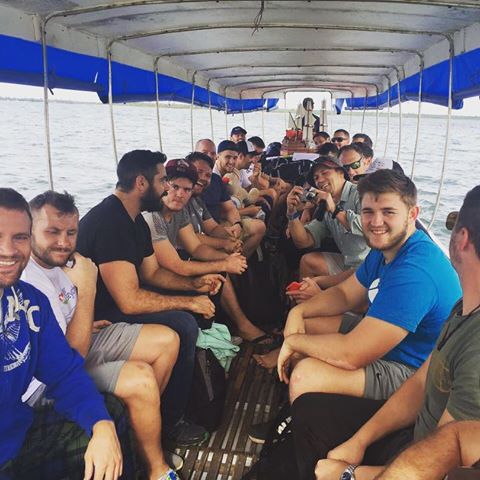
I don’t think any of the gents who were part of the mission team had experienced anything like the conference at Seychelles Airport. “I feel like a rock star,” commented one of the younger members of the team, Charles Etchells, who is studying to be a doctor at Manchester University.

The photos sum up the wonderful experience.

Air Seychelles Mike Ballard Foundation Press Conference

Air Seychelles Mike Ballard Foundation Press Conference

Air Seychelles Mike Ballard Foundation Conquistadors Press Conference - Seychelles Welcome

Air Seychelles Mike Ballard Foundation Conquistadors Press Conference – Seychelles Welcome

Air Seychelles Mike Ballard Foundation Conquistadors - Press Conference Singalong

Air Seychelles Mike Ballard Foundation Conquistadors – Press Conference Singalong

And then it was onwards to Madagascar where we intended to donate 40 wheelchairs and medical equipment to the Aide Manjakasoa Madagascar rehabilitation facility, hold two day’s of rugby coaching with 300 U14 children from 7 clubs and 3 schools; and play the match v the Madagascar national side.

Madagascar

Madagascar. What a place. The third largest island in the world is a developing country where nine out of ten people live on less than two dollars a day. It is also a country where rugby is the national sport with over 48,000 participants, and the national team, ‘the Makis’, are ranked 41 in the world. Put simply, they are rugby mad! Madagascar has the third highest number of registered players in Africa but the majority of rugby playing children (90%) don’t have any uniforms.

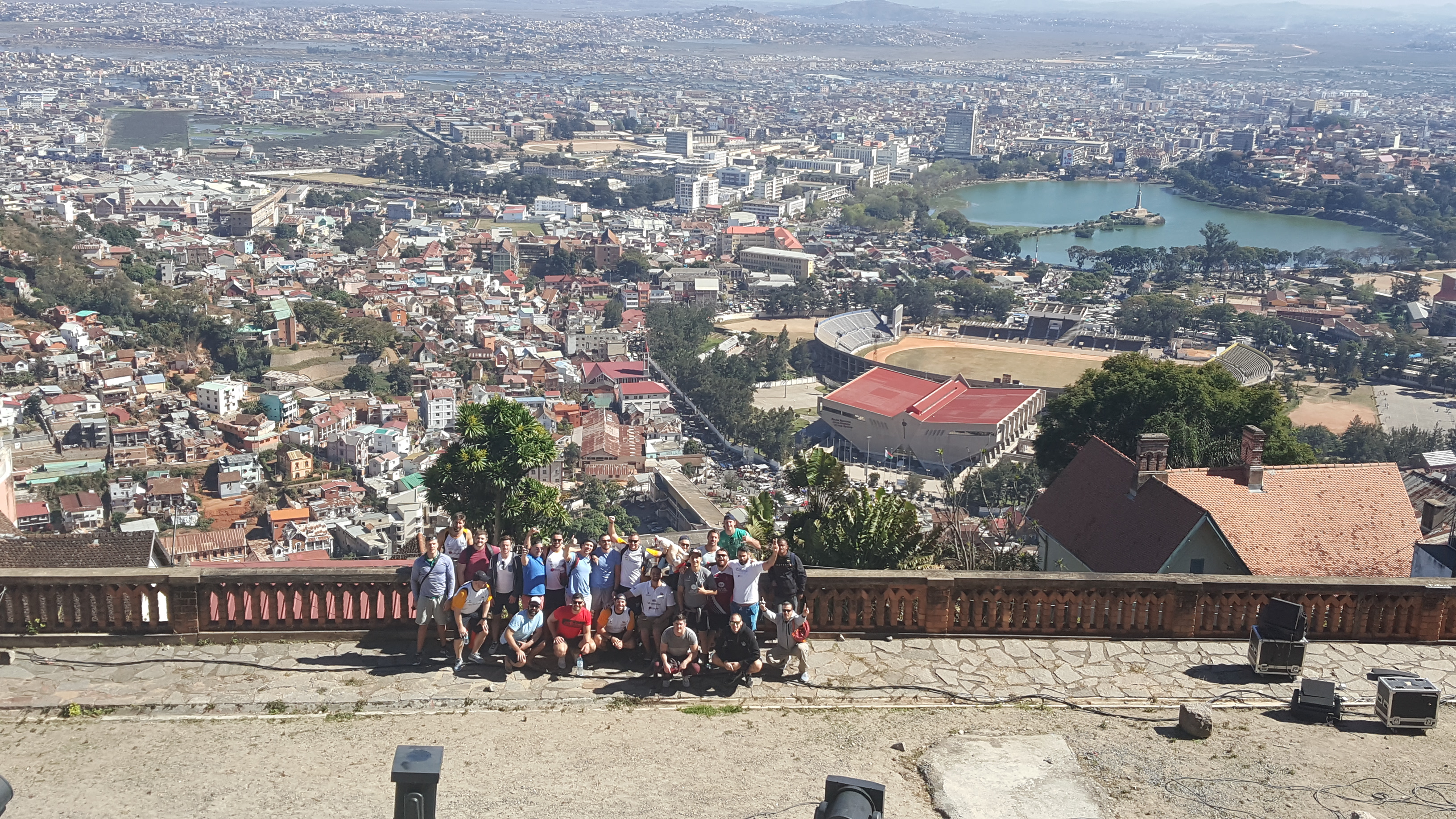
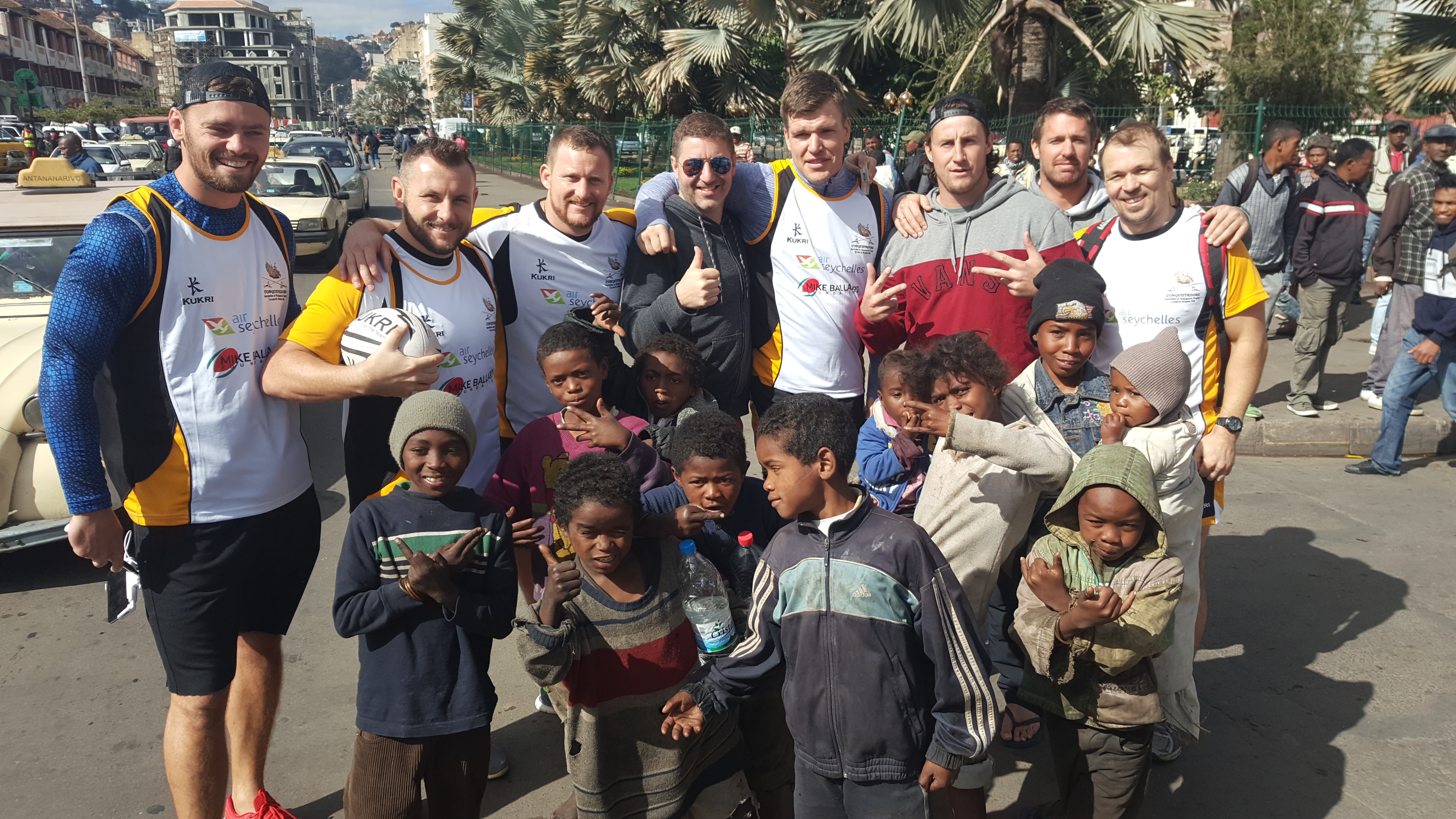
Air Seychelles Mike Ballard Foundation Conquistadors in Antananarivo

Air Seychelles Mike Ballard Foundation Conquistadors in Antananarivo. Mahamasina Stadium where the attack was, is behind.

On the way from the airport to the hotel, the bus went silent. There were thousands of people, all busy, doing something, going somewhere, and they didn’t appear to have much. It was a sobering sight.

Despite not appearing to have much, the Madagascan people had a proud dignity about them – were not pushy and had a good sense of humour. When we started unpacking the gear from the bus on a busy street, rather than try and sell us a set of drums and vuvuzela, the vendors began playing for us – which afterwards resulted in a number of vuvuzela’s being purchased.

Over the ensuing days we:

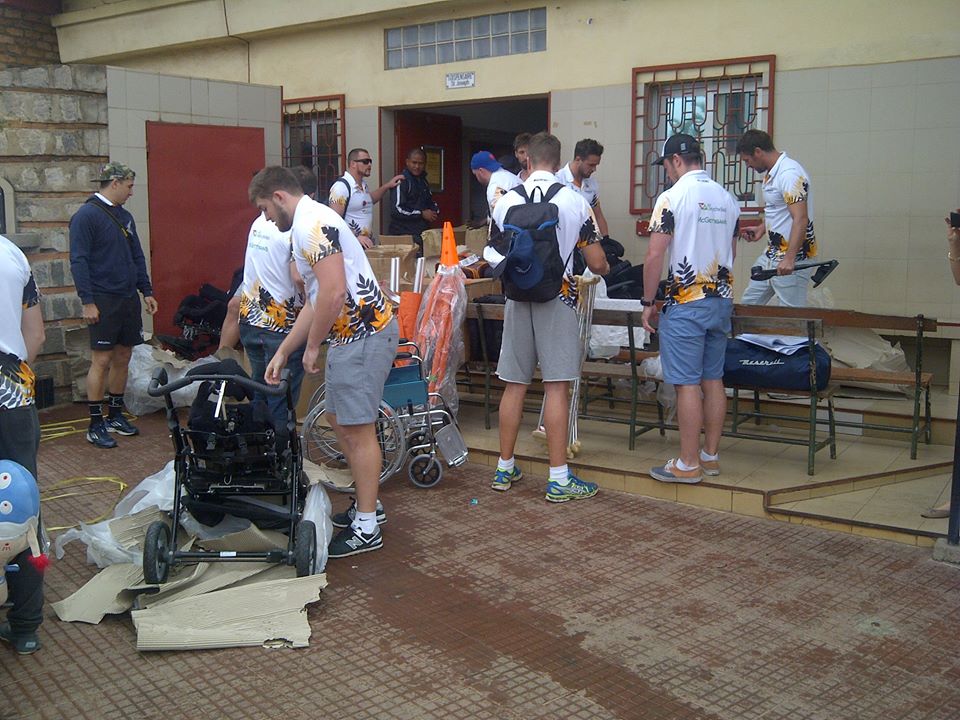
  • Donated 40 wheelchairs and medical supplies to the Aide Manjakasoa Madagascar charity;
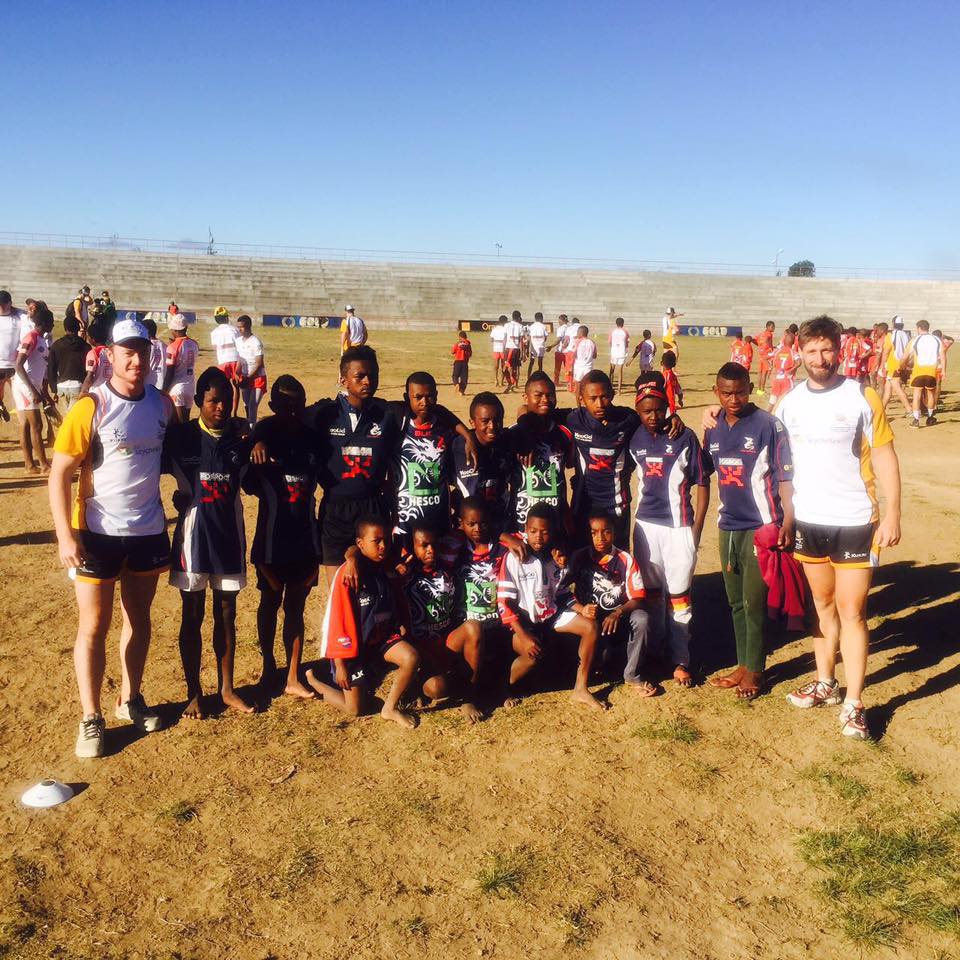
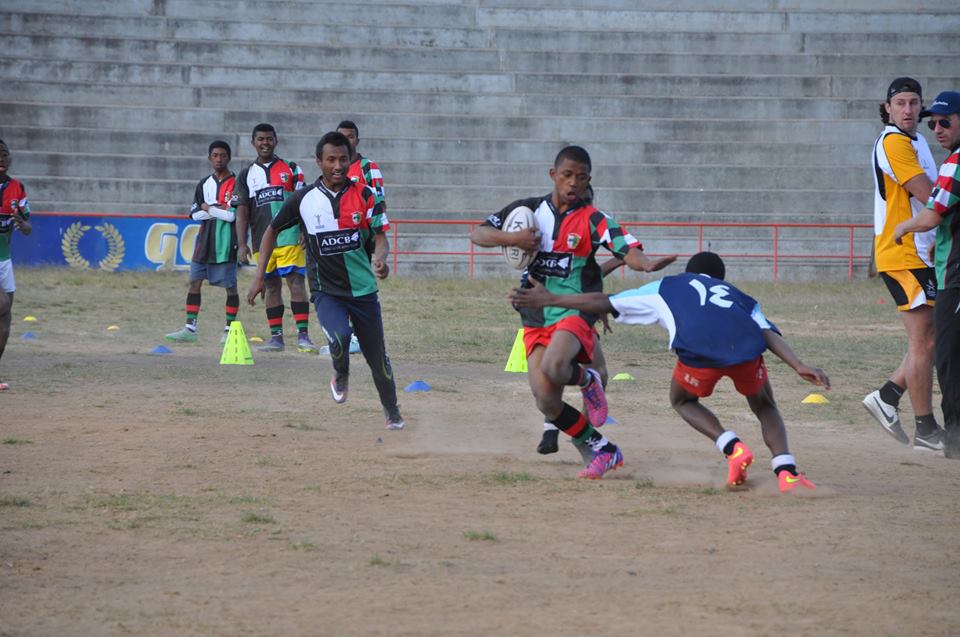
  • Held junior rugby coaching clinics and delivered junior rugby clothing, boots and gear, collected from rugby clubs and schools in the Arabian Gulf region, to rugby clubs in the Antananarivo region; and
  • Played an ‘exhibition match’ against the Madagascan Rugby Team, the Makis (the Malagasy name for the ‘ring-tailed lemur’), currently ranked at No.42 in the world.
Air Seychelles Mike Ballard Foundation Conquistadors donate 40 wheelchairs and medical equipment to the Aide de Manjakasoa Charity, Madagascar

Air Seychelles Mike Ballard Foundation Conquistadors donate 40 wheelchairs and medical equipment to the Aide de Manjakasoa Charity, Madagascar

Air Seychelles Mike Ballard Foundation Conquistadors Rugby Coaching Clinics, Day 1, 30 June 2016.

Air Seychelles Mike Ballard Foundation Conquistadors Rugby Coaching Clinics, Day 1, 30 June 2016

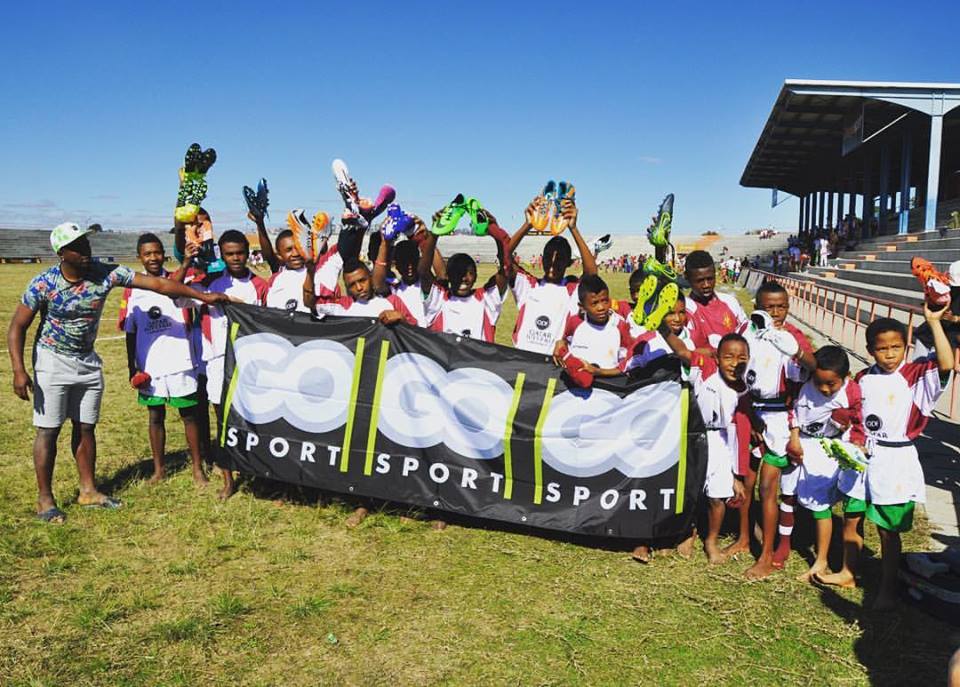
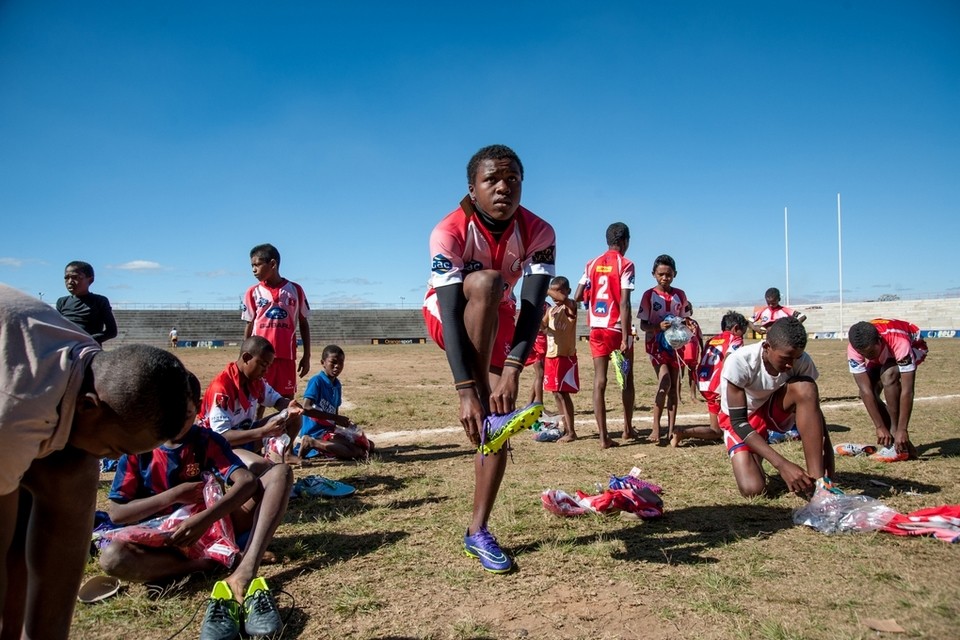
The boots kindly donated by GoSports were a real hit!

The boots kindly donated by GoSports were a real hit! Children here are also wearing kindly donated Doha Rugby Football Club uniforms.

Highlights included:

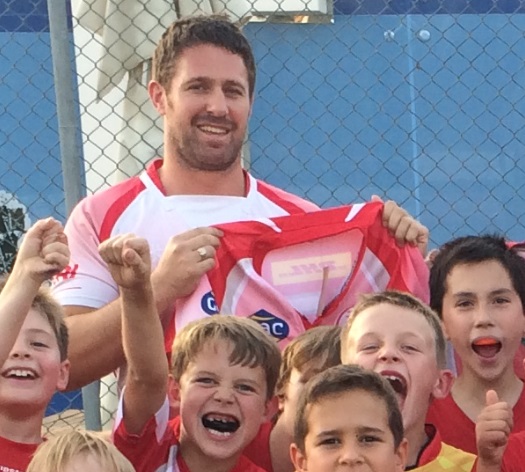
  • Seeing the smiles and gratefulness on the children’s faces when they received new uniforms and boots.
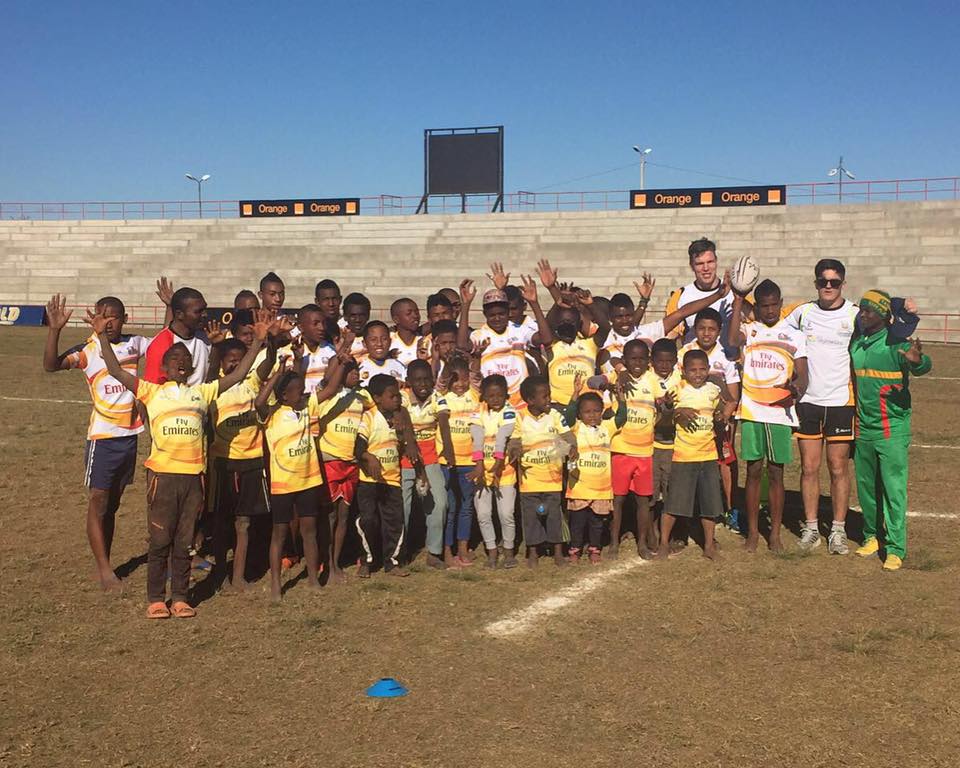
The Dubai Hurricanes shirts kept popping up all over Antananarivo!

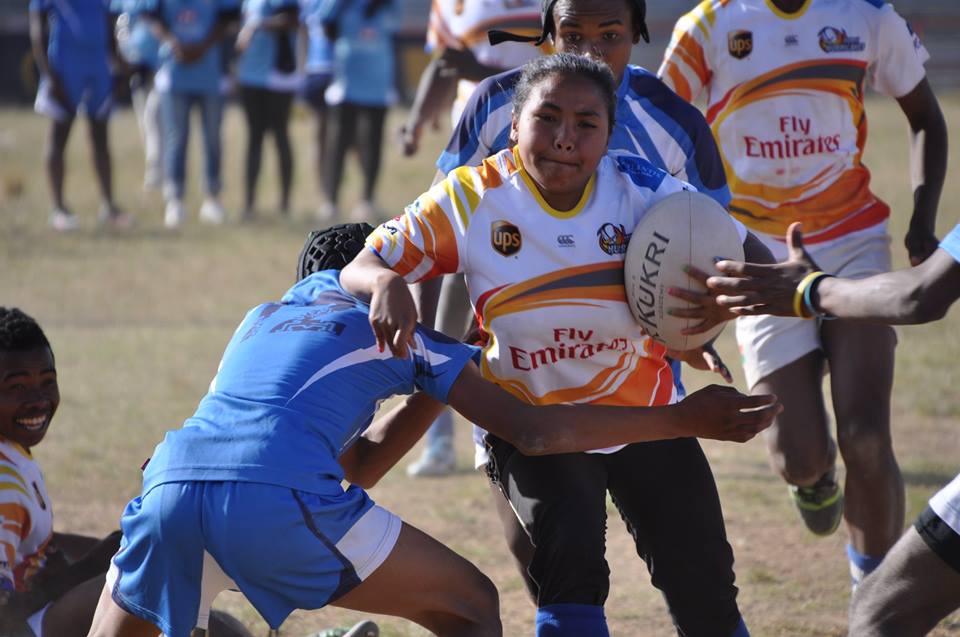
The Dubai Hurricanes shirts kept popping up all over Antananarivo! Both junior girl and boy rugby players had phenomenal skills!

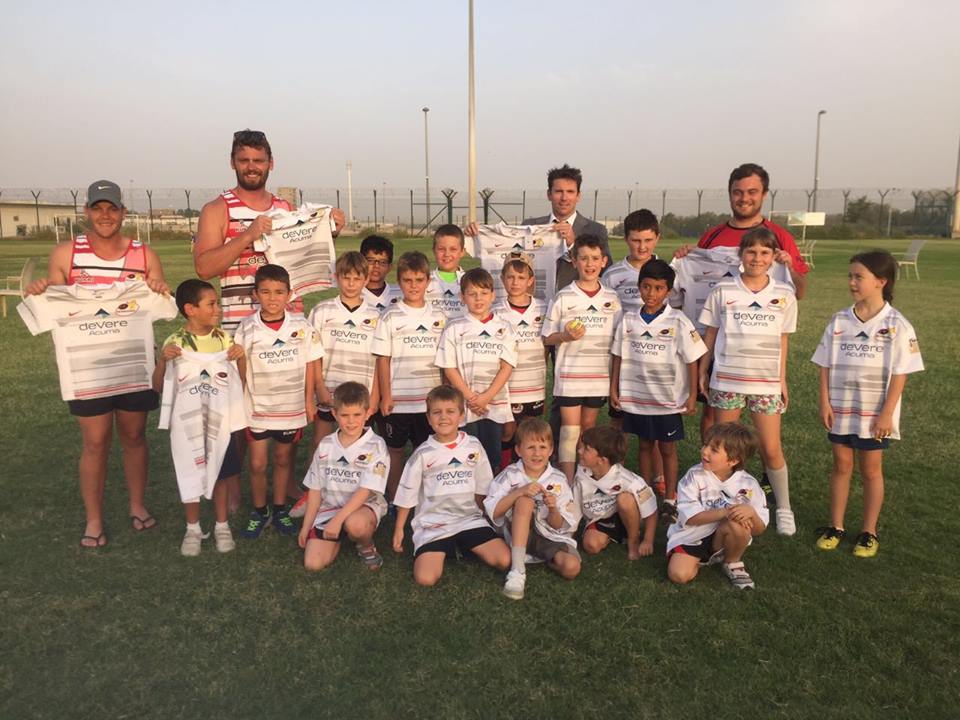
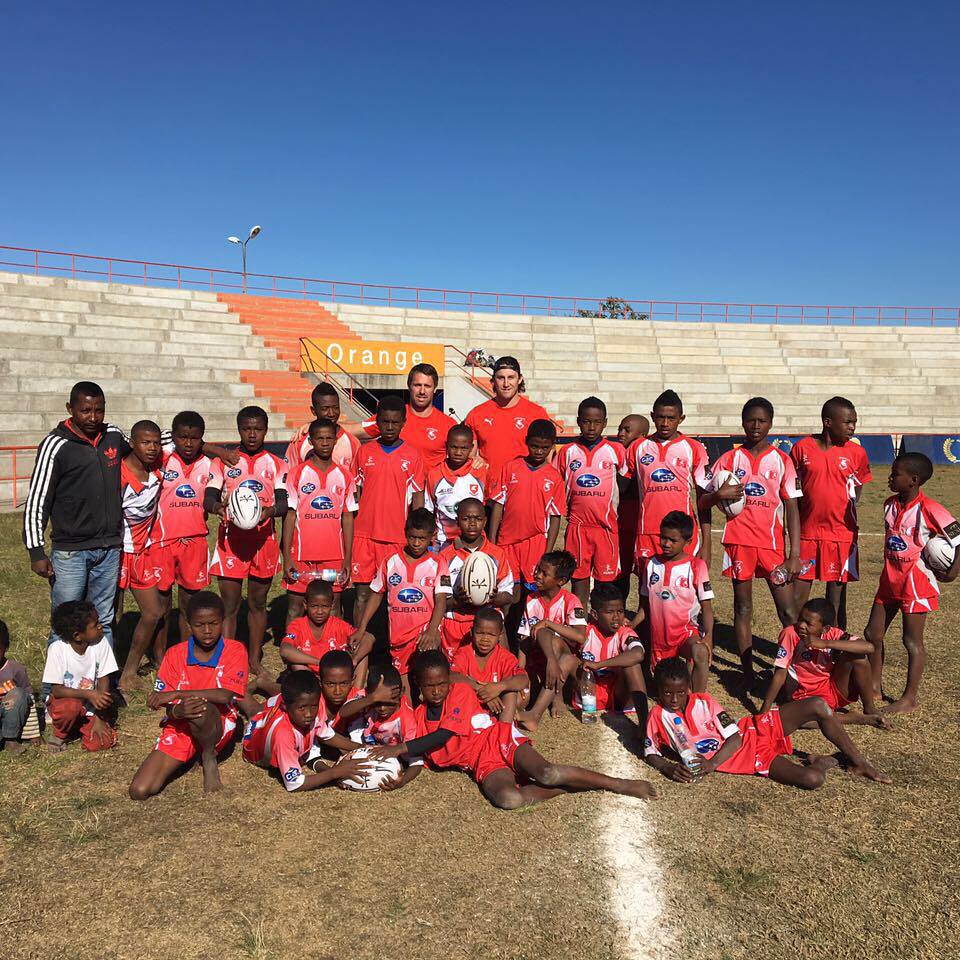
Abu Dhabi Saracens were the first to donate a full set of junior kit.

Abu Dhabi Saracens were the first to donate a full set of junior kit

And the result in Madagascar - a full team kitted out in Abu Dhabi Saracens kit!

And the result in Madagascar – a full team kitted out in Abu Dhabi Saracens kit!

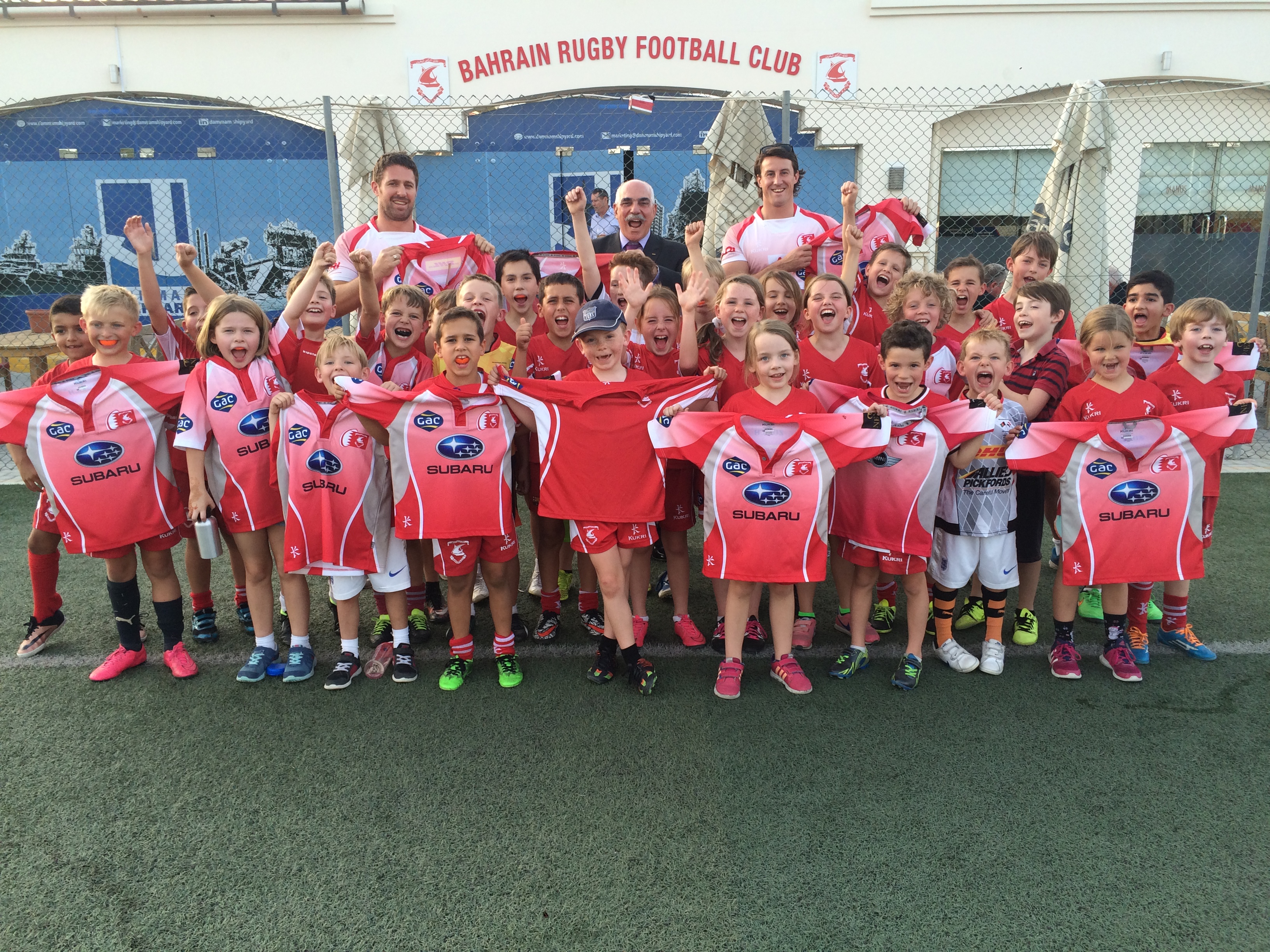
Bahrain RFC did a fantastic job of mobilising the community

Bahrain RFC did a fantastic job of mobilising the community

Bahrain RFC Kit was a real hit in Madagascar!

Bahrain RFC Kit was a real hit in Madagascar!

—Abu Dhabi Harlequins kit proved very popular, the team well coached by Guiness World Record Holder Tom Calnan

Abu Dhabi Harlequins kit proved very popular, the team well coached by Guiness World Record Holder Tom Calnan

The Dubai Hurricanes were incredibly generous, donating the most of any club!

The Dubai Hurricanes were incredibly generous, donating the most of any club!

Adam Telford, retiring UAE captain, was a fantastic asset to the mission, the Jebal Ali Dragons kit very popular

Adam Telford, retiring UAE captain, was a fantastic asset to the mission, the Jebal Ali Dragons kit also very popular!

British School of Al Khubairat Director of rugby sought to build a bridge between Antananarivo and Abu Dhabi, sharing penpal letters from Abu Dhabi.

British School of Al Khubairat Director of rugby sought to build a bridge between Antananarivo and Abu Dhabi, sharing penpal letters from Abu Dhabi.

  • Seeing how good the Madagascan juniors were at rugby – their skills, offloads, and physicality rivalled junior rugby growing up in New Zealand.
The Abu Dhabi Harlequins rugby kit was gratefully received.

The Abu Dhabi Harlequins rugby kit was gratefully received.

  • Practicing lineouts on the streets of Antananarivo, and then giving the balls to the children who scampered down the street with big grins passing and doing backline moves
Lineouts on the streets on Antananarivo, Madagascar

Lineouts on the streets on Antananarivo, Madagascar

These children took off down the street doing backline moves reminicent of the Otago Highlanders when we gave them a ball.

These children took off down the street doing backline moves reminicent of the Otago Highlanders when we gave them a ball

  • Unwrapping the wheelchairs at the Aide Aide Manjakasoa – logistically getting them there had been a mission in itself.
Unwrapping the wheelchairs at the Aide de Manjakasoa charity felt good especially after all of the hard work that went into getting them there, especially by our logistics guru Wade Quinn

Unwrapping the wheelchairs at the Aide de Manjakasoa charity felt good especially after all of the hard work that went into getting them there, especially by our logistics guru Wade Quinn

  • Playing a match against the Madagascan National side, when it looked very unlikely following the terrorist attack.
Air Seychelles Mike Ballard Foundation Conquistadors V Madagascar

Air Seychelles Mike Ballard Foundation Conquistadors V Madagascar, 3 July 2016


Air Seychelles Mike Ballard Foundation Conquistadors V Madagascar

Air Seychelles Mike Ballard Foundation Conquistadors V Madagascar, 3 July 2016


Air Seychelles Mike Ballard Foundation Conquistadors v Madagascar

Air Seychelles Mike Ballard Foundation Conquistadors v Madagascar

  • It was wonderful to have seven of the clubs in the Gulf playing together side by side – Abu Dhabi Saracens, Abu Dhabi Harlequins, Bahrain RFC, Doha RFC, Dubai Hurricanes, Dubai Sharks, Jebal Ali Dragons, and British School of Al Khubairat –  a throwback to the Arabian Gulf days.

Air Seychelles Mike Ballard Foundation Conquistadors had representatives from eigh Arabian Gulf Clubs

We were lucky to play a match at all. Following the attack on the stadium, all public events were banned – understandably. Initially, months earlier, we were informed that the game was to attract over 30,000 people. After the event, however, we were informed that we could play, but with no crowd – it would have been too much of a security risk. We were disappointed of course – we all wanted to play in front of 30,000 people, but in the big picture, the objective of the mission was the charity work – and we still managed to complete that.

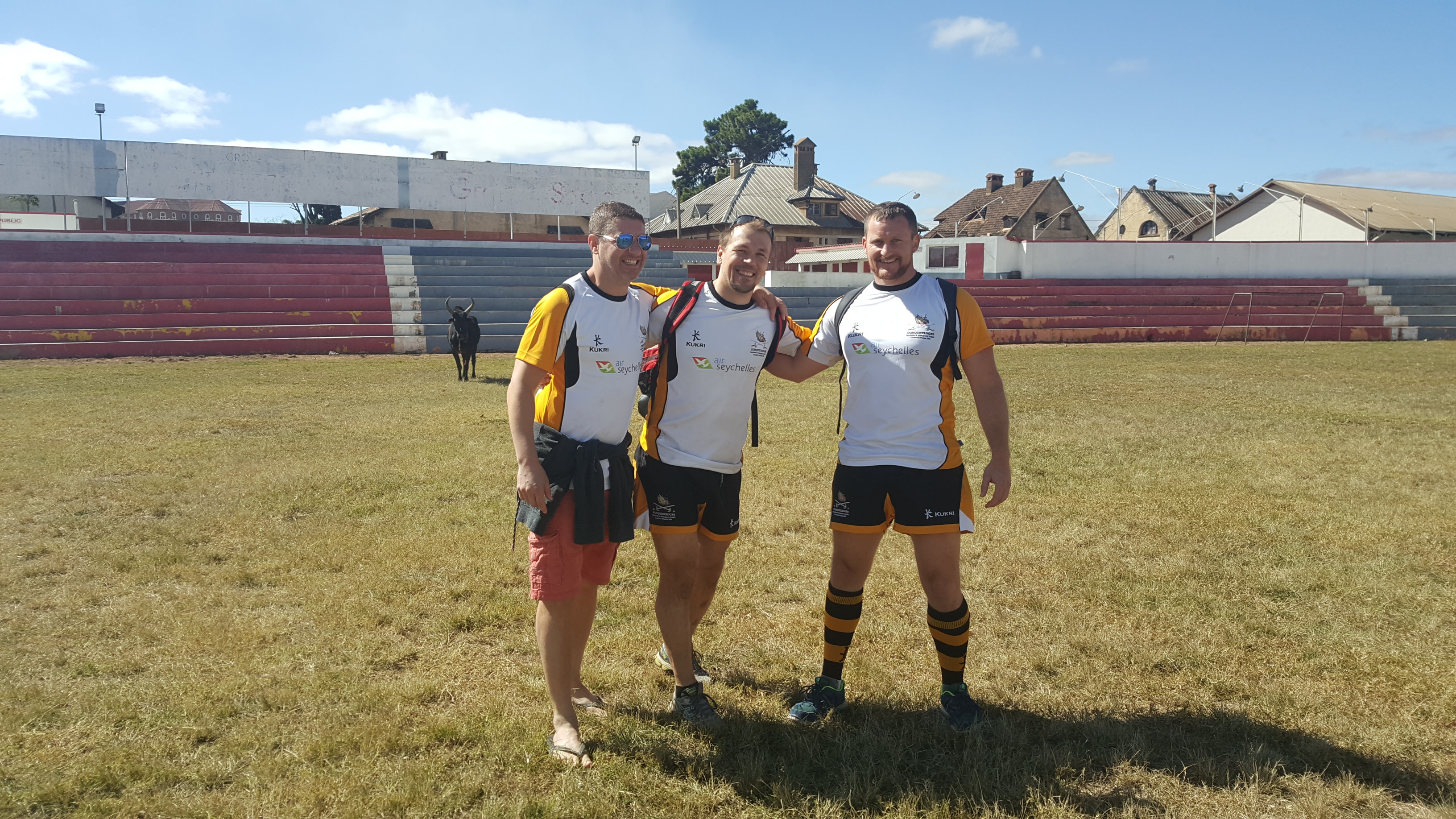
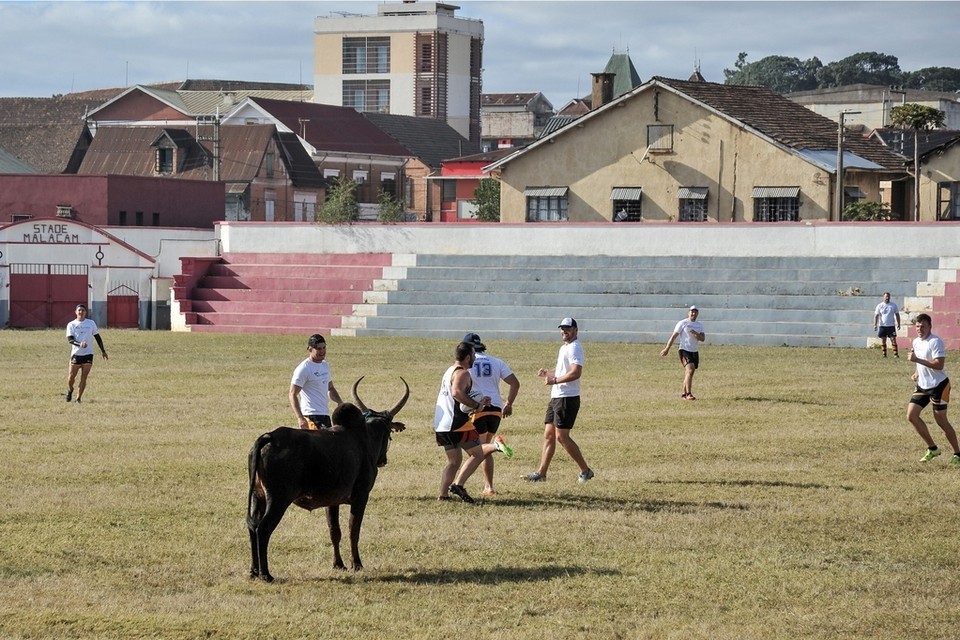
Finding a stadium also proved to be a mission – with the Mahamasina Stadium out of action, and the ‘Makis Stadium’ hard as a rock and with a number of sizeable holes in it, a ‘SWOT’ team of Tom Calnan, Edward Lewsey and Winston Cowie went on a mission to view other options. We didn’t have to go far – a 20 minute walk from the Hotel was the Stade Malacan, replete with lush, springy grass, and a resident bull.

20160701_105841_003

We managed to find a stadium

We managed to find a stadium, with its own hazards!

We had a venue.

On the match, there were strong performances from centres Stephen Hamilton (Abu Dhabi Saracens), Adam Wallace (Bahrain RFC), half back Ed Lewsey (Abu Dhabi Harlequins), and in the forwards Harry Seward and Graham Murphy (Abu Dhabi Harlequins). Tries were scored by centre Adam Wallace (Bahrain RFC), Winston Cowie (Abu Dhabi Saracens), Ed Lewsey (Abu Dhabi Harlequins), and Harry Seward (Abu Dhabi Harlequins).

Sam Wilson (Bahrain RFC) was named co-captain for the match with Adam Telford (Jebal Ali Dragons) – both have contributed a huge amount to Arabian Gulf rugby – and both were playing their last big matches. Adam, unfortunately had to fly back to Abu Dhabi as the match was postponed to find a suitable ground – so it was Sam Wilson who captained the side.

Sam Wilson, Bahrain RFC, was chosen as co-captain in his last match in the Arabian Gulf, bringing to a close a stellar 10 year contribution to Bahrain and Gulf rugby

Sam Wilson, Bahrain RFC, was chosen as co-captain in his last match in the Arabian Gulf, bringing to a close a stellar 10 year contribution to Bahrain and Gulf rugby

“It was a real honour to captain an Arabian Gulf side in my last match here – for me, having played against many of the guys from the clubs, in addition to having the national teams – the likes of the UAE and Qatar, its also awesome to have an Arabian Gulf side to do something charitable, play some rugby, and get to know those guys from the other clubs. It will be really good in the next year for all of these guys to now know each other when they play against each other. It’s an amazing rugby region – I’ve enjoyed my time here, and yeah, a real honour to play footy with these guys.”

The final score was 55-26 to Madagascar, the Conquistadors winning the second half 26-19.

Newspaper coverage – The National – Paul Radley

The goodwill mission was expertly covered by experienced journalist, The National newspaper’s Paul Radley.

Paul completed the below articles, and the following video which gives a real indication of the Air Seychelles Mike Ballard Foundation Conquistadors Goodwill Mission 2016.

Videos

Team Dubai Sports City Training Camp Video. Click here.

Air Seychelles Mike Ballard Foundation Seychelles and Madagascar Goodwill Mission Video. Click here.

Newspaper Articles

Air Seychelles Mike Ballard Foundation Conquistadors Rugby Mission to go ahead despite security concerns

Air Seychelles Mike Ballard Foundation Conquistadors Rugby Mission to go ahead despite security concerns

Mike Ballard

Mike Ballard

GoSports kind donation of rugby boots were gratefully received

GoSports kind donation of rugby boots were gratefully received

Finding an alternative pitch had its own hazards

Finding an alternative pitch had its own hazards

Practising the haka with the local children

Practising the haka with the local children

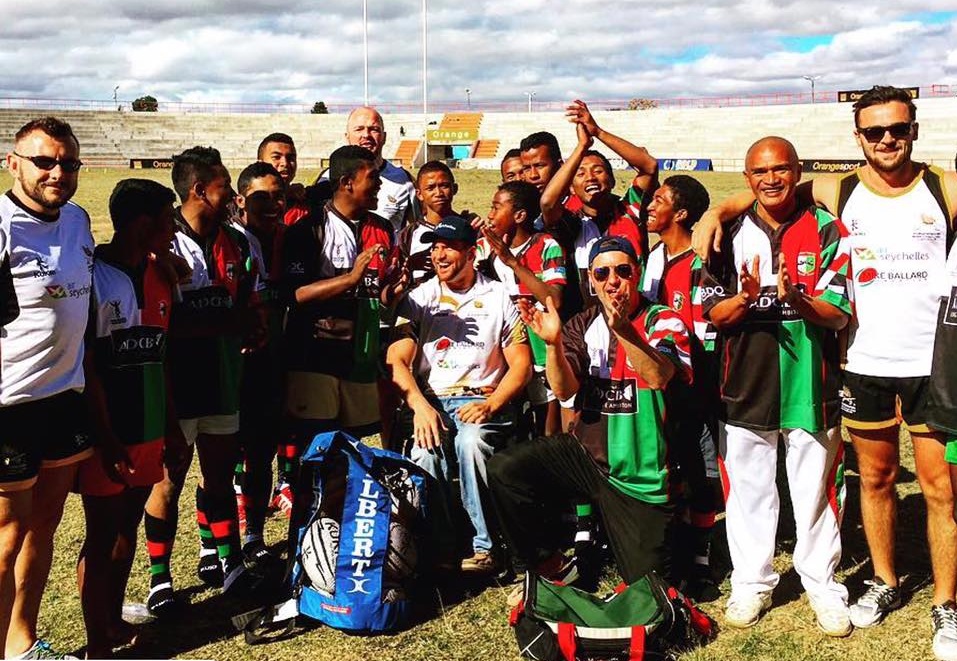
Air Seychelles Mike Ballard Foundation Conquistadors and the Madagascar National team

Air Seychelles Mike Ballard Foundation Conquistadors and the Madagascar National team

Sponsors

A massive massive thank you to all of the Air Seychelles Mike Ballard Foundation Conquistadors sponsors who made this goodwill mission possible. We simply could not have done it without your kindness and generosity!

Air Seychelles Mike Ballard Foundation

Hill International Mike Ballard Foundation Conquistadors

Mcgettigens Mike Ballard Conquistadors

Kukri Mike Ballard Conquistadors

GoSport QBJ ok

Live Nation Middle East

Model

ALEC logo

King&Wood Mallesons


Malagasy Rugby

A massive thank you to Malagasy Rugby for hosting us and showing us around Madagascar – what an incredible country!

madagascar rugby union

Who could forget our boat trip across a lake full with crocodiles? And those lemurs….

Watch out for crocodiles.

Watch out for crocodiles.


20160705_091943 20160705_092639


Many thanks to all sponsors, Malagasy rugby and the Arabian Gulf rugby community.

We all feel incredibly grateful to be a part of such a wonderful rugby community – the Arabian Gulf. Together we have achieved something pretty special.

Until next year.

There are plans in the pipeline…..#onwards

Winston Cowie